AI Image Generator for Personalised Gifts: How the Technology Works
Two years ago, the idea of generating a print-quality custom illustration from a written description in under 90 seconds would have seemed implausible. Today it's a product that thousands of people use weekly.
AI image generators have changed what's possible in personalised gifting — not incrementally, but fundamentally. Understanding how the technology works helps explain both what these tools can do and why the best implementations produce results that are genuinely impressive.
What Is an AI Image Generator?
An AI image generator is a machine learning model trained to produce images from text descriptions (and sometimes from other images). You provide a prompt — a description of what you want to see — and the model generates an image that matches it.
The most capable current models (including Flux, Stable Diffusion, and similar systems) can generate photorealistic images, illustrations in specific artistic styles, and complex compositions — all from text alone. They can also use an existing image as a reference, guiding the style or content of the output.
For gift applications, the relevant capability is style-consistent character illustration: the ability to generate a person who looks like a specific individual, illustrated in a specific artistic style, across multiple panels of a narrative sequence.
How AI Image Generators Work
Without going too deep into the technical details: modern AI image generators are trained on enormous datasets of image-text pairs. Through this training, the model learns associations between concepts in text and visual representations of those concepts.
The generation process works in reverse: starting from random noise, the model iteratively refines the image toward something that matches the text prompt, guided by what it learned during training.
The key developments that made these models genuinely useful for gifts:
Diffusion models. The architecture underlying most current generators. They're particularly good at producing coherent, detailed images with consistent style — important for illustration work.
ControlNet and IP-Adapter. Techniques that let you use an existing image as a reference when generating a new one. This is what makes it possible to generate a character who looks like a specific person — you provide a photo, and the model uses it as a visual reference while applying the target illustration style.
Style fine-tuning (LoRA, DreamBooth). Methods for specialising a model on a specific illustration style. Instead of producing generic AI art, a fine-tuned model produces illustrations in a specific, consistent aesthetic — like the ligne claire style used by MyComicGift.
The Leap to Consistent Characters
The hardest problem in AI image generation for narrative work isn't generating a single impressive image — it's generating multiple images of the same character that all look like the same person.
Early AI image generation was notoriously bad at this. Characters would shift appearance from panel to panel. Faces would become distorted. The same "person" would look different in every frame.
This has improved substantially with newer models and techniques. The key approaches:
Image reference. Using the face photo as a reference at generation time, rather than just at training time. The model sees "this is what the character looks like" and maintains it across the panel sequence.
Character embedding. Creating a consistent internal representation of the character that's applied to every generation request for that character.
Iterative generation with constraints. Generating each panel with awareness of previously generated panels, so characters remain consistent as the story progresses.
From AI Image Generator to Personalised Gift
Using an AI image generator to create a personalised gift requires more than just prompting a model. The gap between "generates impressive images" and "creates a personalised gift someone will treasure" involves several additional layers:
Story generation. The user's brief needs to be expanded into detailed, panel-specific prompts. This is typically done with a language model — the story brief becomes a structured narrative, and each panel gets its own specific prompt.
Character consistency. As discussed above: maintaining the same character appearance across multiple panels requires specific techniques and model capabilities.
Style application. A generic AI image isn't a gift. A consistently illustrated piece in a specific, beautiful style is. The style needs to be applied consistently across all panels.
Output quality. The resolution, format, and colour accuracy need to be suitable for print. Most AI image generators produce web-quality outputs by default; print-quality requires specific output settings.
Editorial judgment. The best outputs aren't necessarily the first outputs. A good AI gift product includes the ability to regenerate, select between alternatives, and make adjustments.
What Makes a Good AI Gift Generator
Not all AI image generators are equally suited to gift creation. The meaningful differentiators:
Character consistency. Can it maintain a consistent character appearance across multiple images? This is the hardest technical challenge and separates the products that produce genuinely impressive results from those that produce inconsistent outputs.
Style quality. Is the illustration style genuinely beautiful and print-worthy? Generic AI art is recognisably generic. A well-chosen, consistently applied style produces results that look like professional illustration.
Narrative coherence. Does the sequence of images tell a story? Or is it a collection of unrelated images with the same character?
Output quality. Are the files suitable for print? A gift that looks great on screen but prints badly is a failure.
The Role of Fine-Tuning and Style
The illustration style is not incidental to the gift — it's central to it. The choice to use ligne claire specifically (the Tintin-inspired European comic style) is a design decision as important as the AI model choice.
Fine-tuning a model on a specific style means training it on examples of that style specifically, so that its outputs reliably match the aesthetic. This is more work than prompting a general model to "draw in the style of Tintin" — it produces more consistent, higher-quality results in that specific style.
The tradeoff: a fine-tuned model is less flexible than a general one. But for a gift product where style consistency is the whole point, this is the right tradeoff.
MyComicGift as an Example
MyComicGift uses the Flux AI image generation model, fine-tuned on the ligne claire style, with IP-Adapter for character reference from photos.
The pipeline:
- User provides a story brief and optional photo
- A language model expands the brief into a structured story bible with panel-by-panel descriptions
- The character is established from the photo reference (if provided)
- Flux generates the cover and each storyboard panel, using the character reference and the fine-tuned style
- The user can regenerate individual panels, creating a feedback loop that improves the output
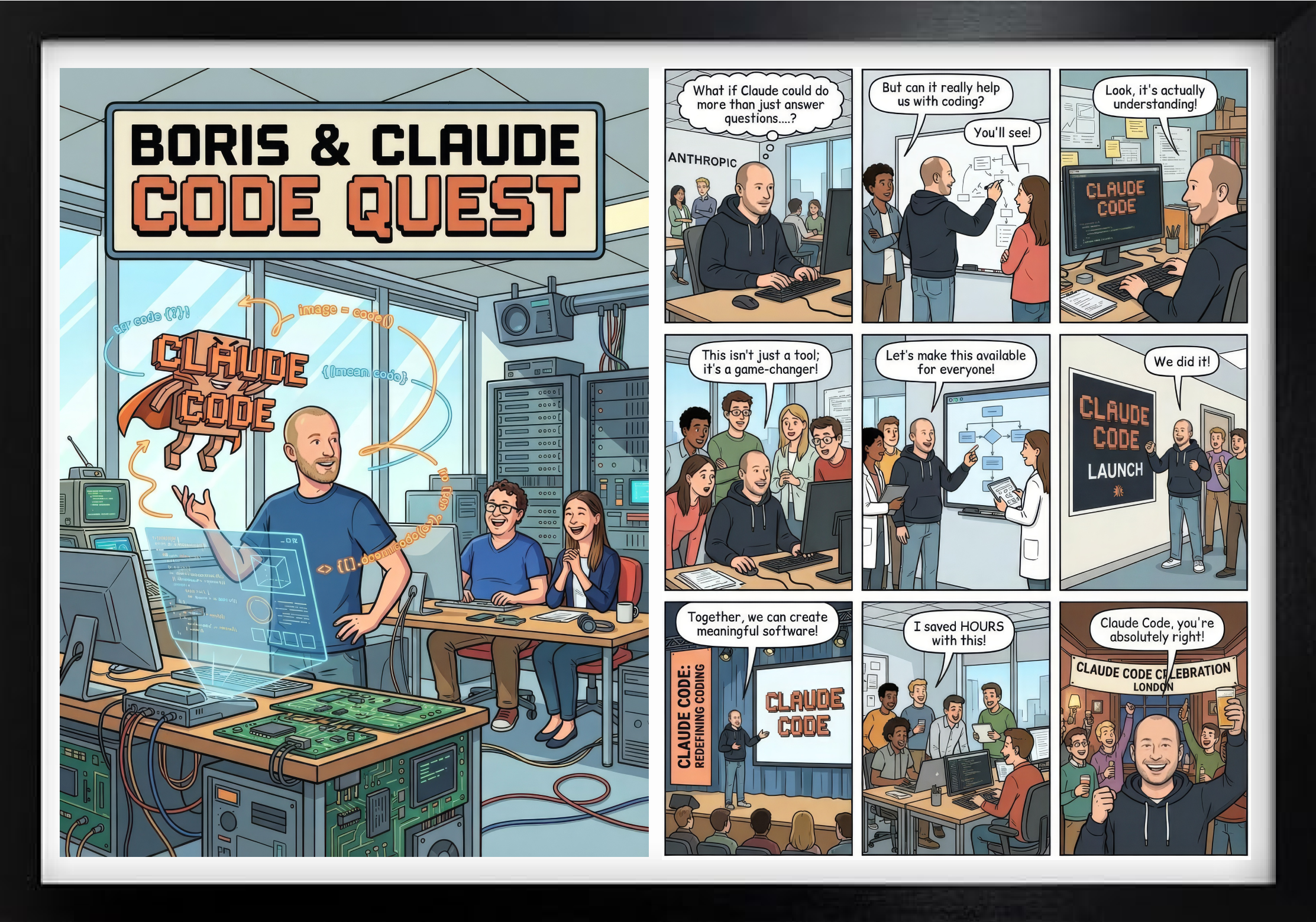
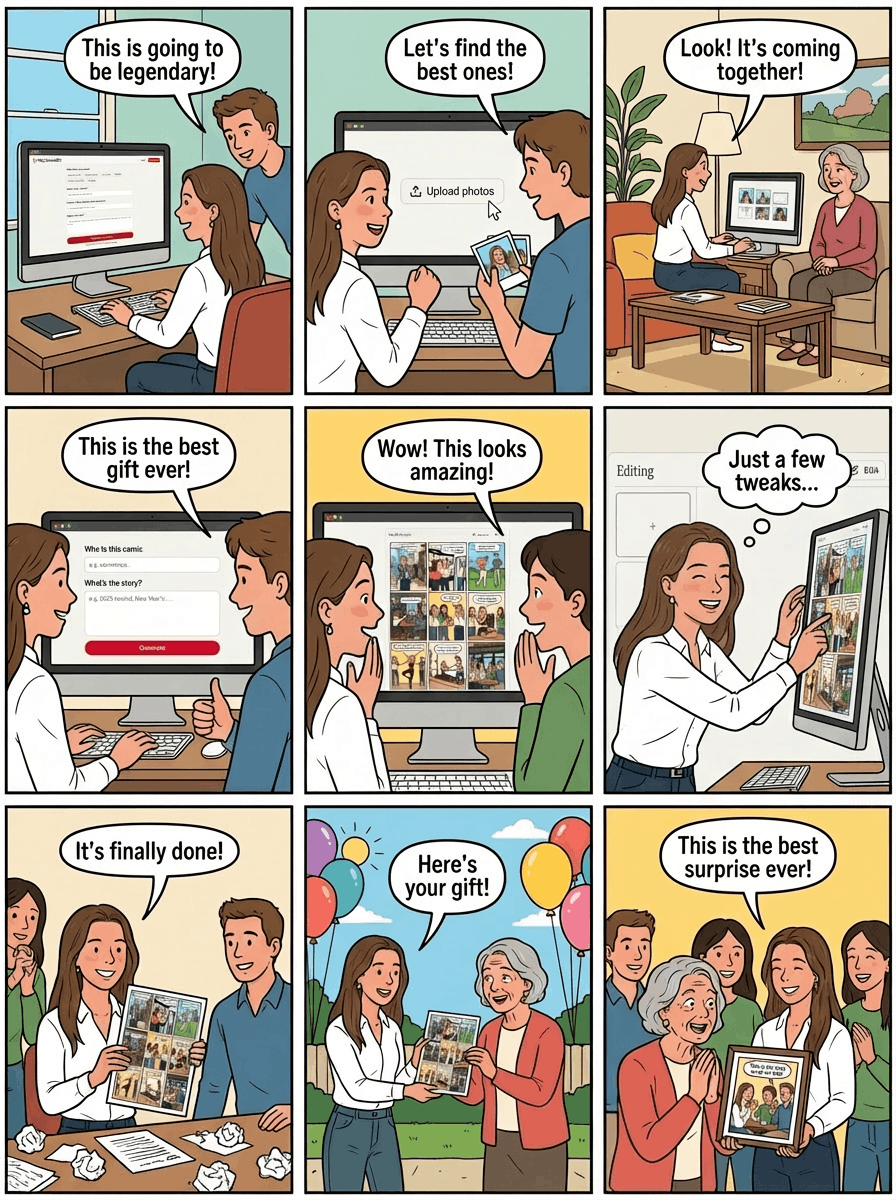
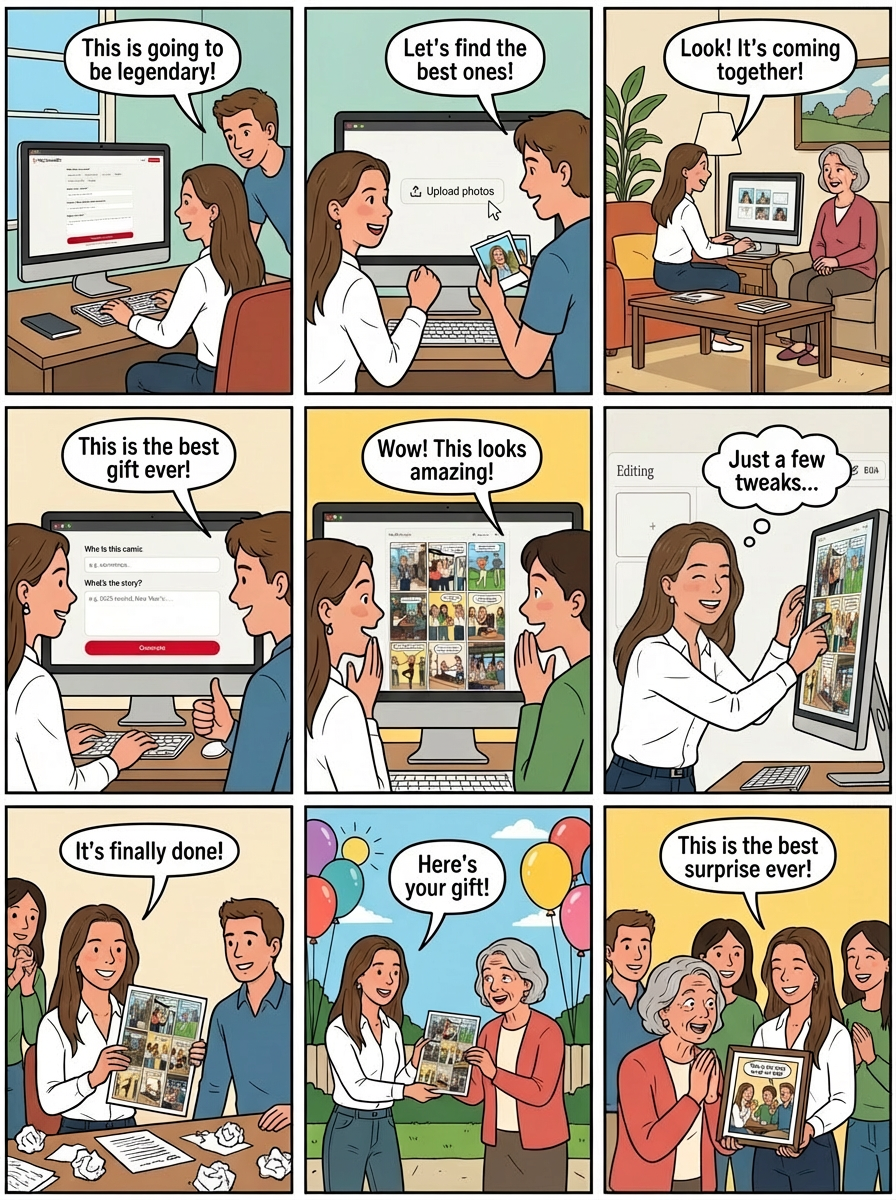
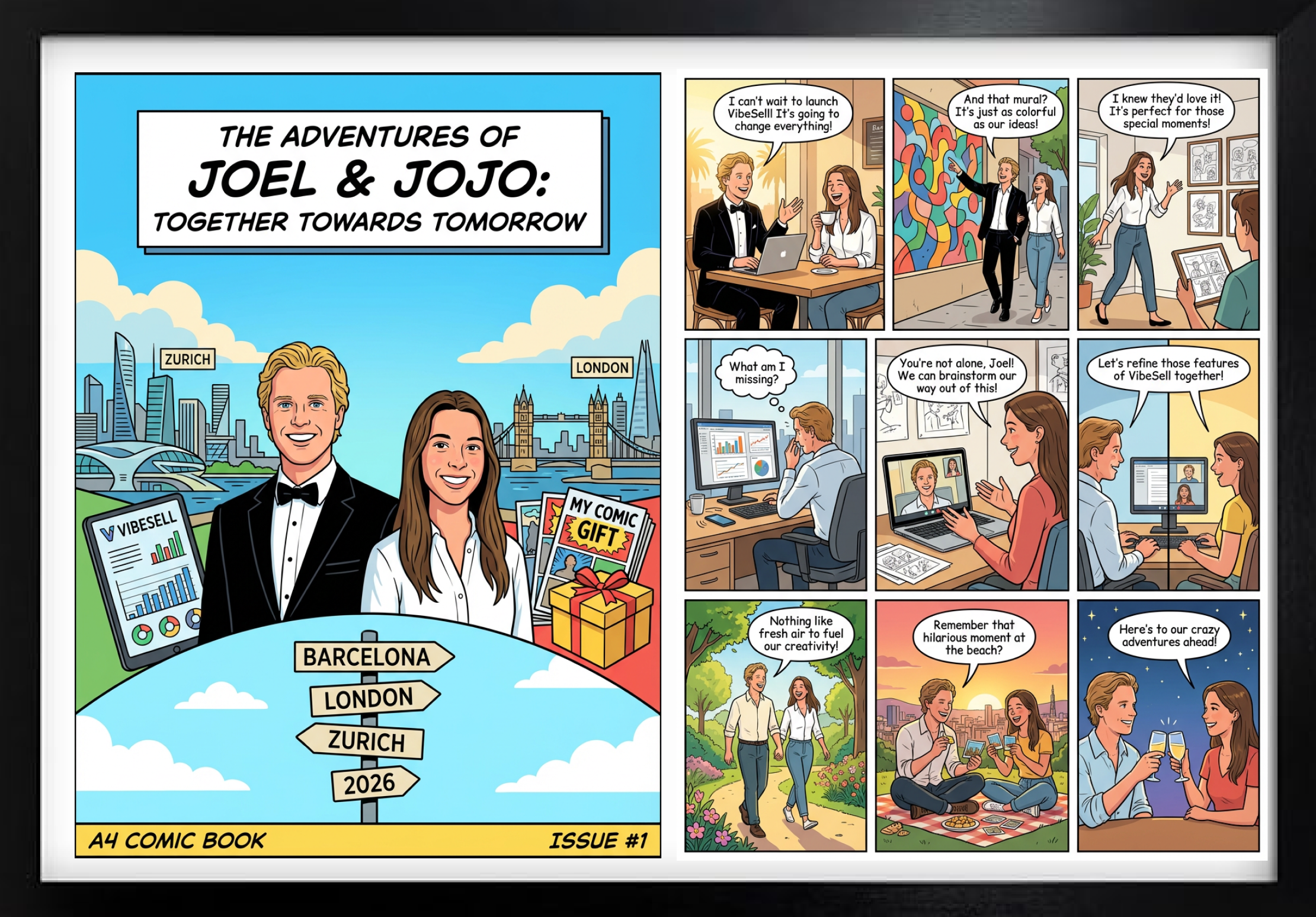
The result is a print-quality comic cover and nine-panel storyboard that's specific to one person, in a consistent illustration style, available in under 2 minutes.
Where AI Image Generation for Gifts Is Going
The technology is improving rapidly. The areas where progress is most visible:
Multi-character consistency. Getting a group of specific people to all look like themselves in the same panel is still harder than single-character work. This is an active area of development.
Video and motion. Animated versions of personalised illustrations are technically possible now. Whether they work well as gifts is a different question — the printable, frameable aspect of a static illustration has a lot of value that a video doesn't.
Feedback loops. Better tools for iterating on results: not just "regenerate" but more specific controls over what changes and what stays the same.
Real-time generation. Generation speeds are falling. The 90-second generation time will likely become 10 seconds within a few years.
See AI image generation for gifts in action
Create a personalised comic from your story in under 2 minutes. First preview is free.
Try it nowAlso read: Flux AI — the specific model behind MyComicGift's comic art and AI-powered gifts: the broader landscape.