From Screen to Frame: How to Print and Display Your Comic Gift
The digital version of your comic is great for sharing instantly. The physical version is what ends up on a wall.
This guide covers everything after the download: how to print your comic, how to frame it, and how to display it in a way that does justice to the illustration.
Your Digital Files Explained
When you download your comic from MyComicGift, you receive high-resolution JPEG files — one for the cover, one for the storyboard.
Resolution: The files are produced at print-ready resolution, suitable for A4 (210 × 297mm) and A3 (297 × 420mm) prints. Going larger than A3 will result in visible quality loss at close range.
Format: JPEG, which is compatible with virtually every print service and home printer.
Colour profile: The files are produced in sRGB, which is the standard for digital display and most consumer print services. If you're using a professional print service with specific colour profile requirements, they'll be able to handle the conversion.
Printing Options
Order a Print From MyComicGift
The simplest option. MyComicGift's print service handles the file preparation, paper selection, and shipping. The prints are produced on quality art paper with colour-accurate printing.
Best for: Gifts being given in person, situations where you want the print to arrive as a finished piece ready to frame, or where you're not confident about local print quality.
Delivery time: Typically 5–10 business days depending on location.
Print at Home
Home printing works if you have a printer capable of A4 or A3 output with good colour accuracy. Most standard inkjet printers handle A4 without issue.
Paper choice matters. Standard copy paper produces a flat, low-contrast result. For a print you'll want to display, use:
- Photo paper (glossy or satin): Rich colours, high contrast. Glossy shows fingerprints; satin is the better choice for display pieces.
- Matte photo paper: Softer finish, no glare. Works well for the ligne claire style, which has a lot of white space.
- Fine art paper (if your printer supports it): The highest quality option. 200–300gsm paper produces a print with real tactile quality.
Use a Local or Online Print Shop
Most high-street print shops and photo labs offer A4 and A3 printing from digital files. Online services (Photobox, Snapfish, printed.com, Vistaprint) offer more options including canvas prints, metallic paper, and large-format output.
For the best result: Request "fine art giclee print" or "photo print on premium satin paper" rather than a standard document print. The paper and ink quality make a significant difference.
If you're giving the comic as a gift, having it printed and framed before giving it adds significant presentation value. The recipient receives a finished piece of art rather than a file to deal with later.
Framing Your Comic
A good frame makes the difference between a print and a piece of displayed art.
Standard frame sizes that work:
- A4 (210 × 297mm) — widely available, works for the cover alone or a single panel
- A3 (297 × 420mm) — better for the full storyboard, fits standard frames
- 30 × 40cm — slightly non-standard but widely available, especially at IKEA (RIBBA frame)
- 50 × 70cm — large format for a statement piece
Frame styles that complement ligne claire illustration:
The clean lines and flat colours of the ligne claire style work well with:
- Simple black frames — classic, high contrast, lets the illustration speak
- White or light wood frames — softer, works well in modern interiors
- Thin metal frames — contemporary, works well with the comic's graphic quality
Avoid ornate or heavily decorative frames, which compete with the illustration rather than complementing it.
Mounting options:
- Mounted (with a white card border): Makes the print look more considered and adds breathing room around the image. Recommended for A4 prints in A3 frames.
- Full bleed (print fills the frame): Works for larger formats where the illustration itself has enough internal space.

Display Ideas
Cover and storyboard together: The two pieces are designed to be displayed as a pair — the cover to the left, the storyboard to the right. Matching frames, aligned at the centre, with a small gap between them.
Cover alone as a statement piece: The comic cover works as a standalone piece of art, framed at A3 or larger. The ligne claire style is bold enough to anchor a wall.
Gallery wall with other art: Comics sit well in gallery walls alongside photographs and other prints. The illustration style creates an interesting contrast with photography.
On a desk or shelf: A smaller A4 framed print on a desk or bookshelf is a good option for a gift you're not sure about displaying on a wall. It's visible but not a commitment.
Which Format to Display
The choice between displaying the cover, the storyboard, or both depends on the space and the preference of the recipient:
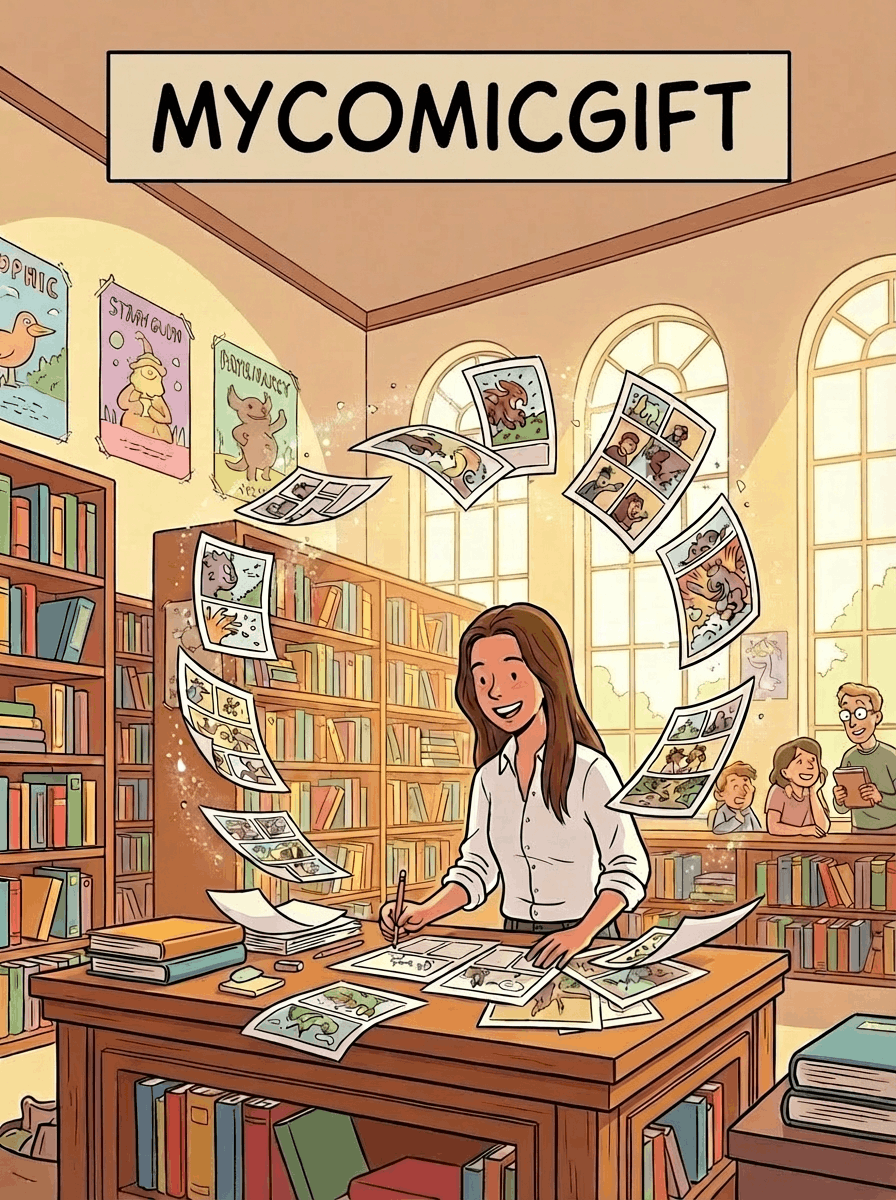
The cover is the single most visually striking image — the hero prominently featured, a clear title, the full colour palette of the illustration. This is the piece for a large empty wall.
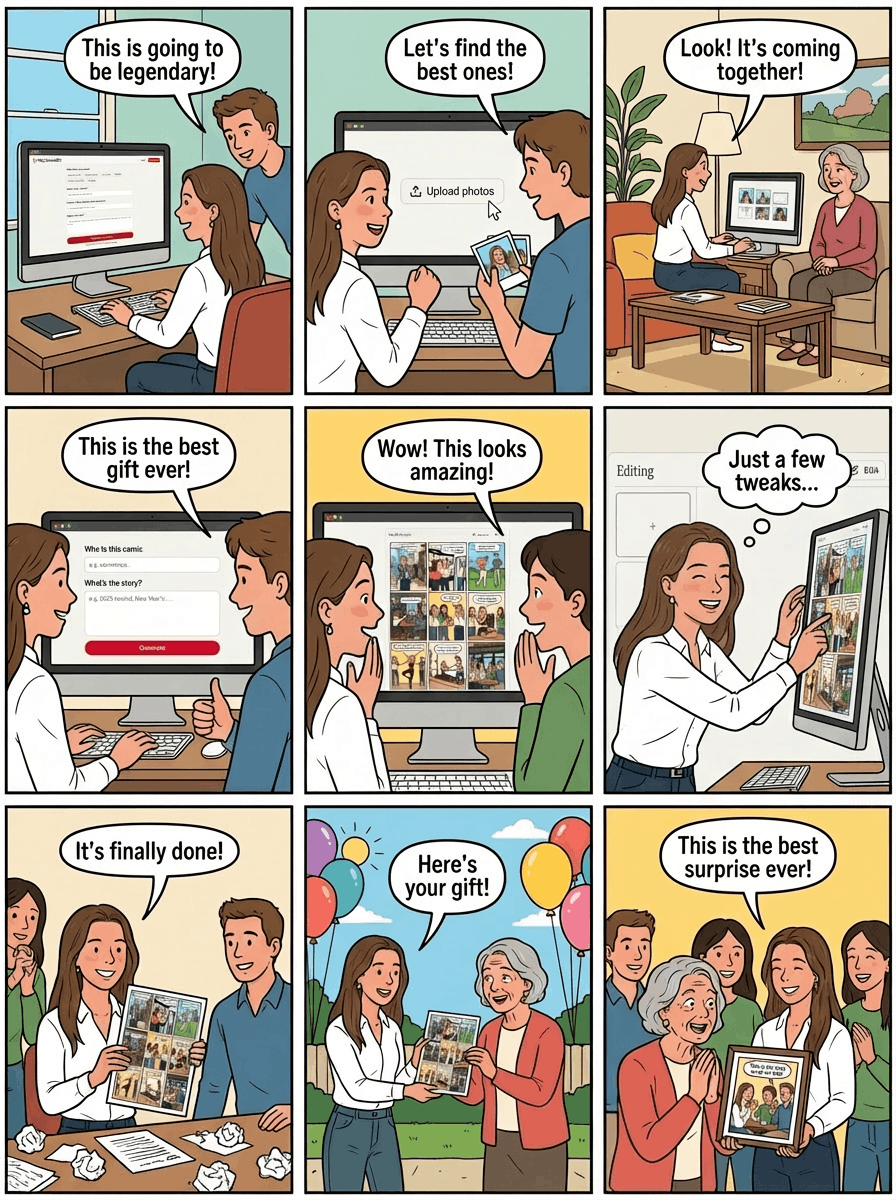
The storyboard tells the story — nine panels that reward closer inspection, with more detail and narrative to discover. This is the piece for a space where people spend time and look at things closely.
Both together gives you the complete comic: the cover sets the scene, the storyboard tells the story. The ideal display if the wall space allows it.
Order your print bundle
High-quality prints of your comic cover and storyboard, delivered ready to frame.
See print optionsHaven't created your comic yet? Start with what is a personalised comic gift or go straight to the editor to create yours.